
One Perfect Weekend in John Day Fossil Beds National Monument

[Shaniko / Mitchell, OR, Oct 17-19, 2025]
With October weather continuing to hold steady, I took my second last-minute trip of the month to John Day Fossil Beds National Monument. Just like with the golden larches, we booked this trip just the week before when we realized the weather will cooperate. I was excited because John Day had been on my list for a while.
When to Visit
John Day is located in north-central Oregon’s high desert. Because of that, summers are quite hot and winter can be cold and windy. Fall and Spring are the best times to visit. Although the area is a desert now, it was once a wet, subtropical environment teeming with life, which is why it has such a rich fossil record.
Where to Stay
John Day is quite far from well-populated areas. The closest town is Mitchell, which is tiny and only has one motel and a vacation rental. Most people who stay in the area choose to camp. The next closest town is Prineville. It has a couple of 2-star hotel chains and more dining options, but it is an hour away from John Day. We wanted something a bit nicer for our lodging, so we decided on Redmond. The Lodge at Eagle Crest was a great value for all the amenities, which included an outdoor hot tub (which we used) and indoor pickleball courts (which we didn’t have a chance to use). There are also a couple of restaurants on site, walking trails and a golf course. Staying in Redmond only added about 25 minutes each way to our drive compared to Prineville.
I would normally not volunteer for extra distance. But the three units of John Day are far away from each other, which means that no matter where you stay, you’ll be driving a lot.
Itinerary
This itinerary can be done over a regular weekend from Portland, OR or any other place within 3-ish hours from John Day.
Day 1, Friday – Drive to your overnight accommodations, optional detour to Shaniko ghost town
We left around noon on Friday and we had just over 3 hours to our hotel in Redmond. As soon as we got over to the east side of Mt Hood, the scenery changed dramatically. It was flat and desert-like! It didn’t even feel like Oregon!

Since we left so early in the day, we decided to detour to Shaniko ghost town. It added an extra 30 minutes each way, plus the time we spent in Shaniko itself.

Shaniko is a historic “living” ghost town – the current population is about 30 people. In the early 20th century, it was the Wool Capital of the World. A railroad stopped here and it helped the town grow. But when a competing railroad bypassed the town, the population declined.

Many historic buildings remain and are open to the public. The whole town has an awesome Old West vibe. And wool from Shaniko is still a thing! In fact, some US 2026 Winter Olympics uniforms were made using Shaniko wool.


Most buildings were closed since we arrived around 4:30 pm on a Friday in October. You have a better chance of buildings being open if you visit during the day April – September. We were just as happy to see everything from the outside, though.


The Clarno unit of John Day is another 45 minutes from here. If you really want to visit it, leave Shaniko for another day and add the Clarno Unit to that. It is the least visited unit of John Day and the 3 trails listed on the park website all just a quarter mile long. It didn’t seem worth the extra driving to us, so we skipped it.
Day 2, Saturday – Painted Hills and Sheep Rock Units
The Painted Hills unit is the most visited one. It is located about 10 miles north of the town of Mitchell.

The distinct colorful layers of the claystone formed over 35 million years ago when pumice and ash from volcanic eruptions in the Cascade Mountains settled over the area. They represent different geological periods and environmental conditions, essentially providing a record of how the climate changed over time. The bright red layer contains iron-rich soil deposited during warm and wet climate; the yellow/tan layer denotes cooler, dry periods, and the black layer is full of plant life.


Three of the best trails in the unit are in the same general area. Two of them even share a parking lot!
Painted Hills Overlook
The Painted Hills Overlook trail is just over a mile long. It leads to a viewpoint of the colorful rolling hills. There are some exhibits at the trailhead with information about the hills and the park. I was wondering who John Day was, and the signs had the answer! He was a fur trader who came to Oregon in 1812. He was robbed of all his belongings where the Mah-hah river meets the Columbia. The story of his robbery became well known and the Mah-hah river was then re-named after him. He never actually came to this area. Thomas Condon, who will learn about a little later, named the area after the John Day river because of the river’s role in eroding and exposing fossil-bearing rock layers.


Carroll Rim Trail
The 1.6-mile Carroll Rim trail begins across from the Painted Hills Overlook. It’s a short but steep climb to the top, but the views are worth it!


Painted Cove Trail
The Painted Cove Trail is a quarter-mile around some dramatic-looking red and deep orange hills. A section of the trail has a boardwalk, which makes for excellent photos and videos. Seeing a video of this trail on Instagram is what put John Day on my radar! Although this was not exactly an “Instagram vs Reality” situation, the trail felt a little underwhelming, especially after the first two!


Lunch in Mitchell
You have no choice but to go through Mitchell on the way to the Sheep Rock Unit, but it was also the only place where we could get some food! There are only a handful of restaurants here but they all seem to have great reviews! We chose Tiger Town Brewing because of their inviting outdoor patio. We were starving and even though the food took a bit of time to arrive, it was delicious! I devoured my fish and sweet potato fries!


The Sheep Rock unit
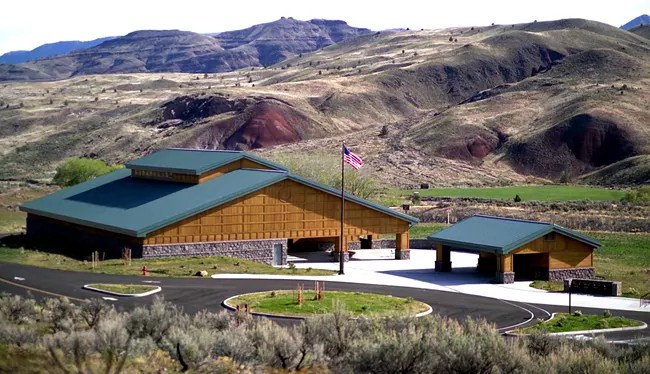
It takes just under an hour to get to the Sheep Rock Unit from the Painted Hills. We drove by the Thomas Condon visitor center, which was sadly closed due to the government shutdown at the time. It is definitely worth a visit if it’s open, as it contains fossils from the area. The visitor center is named after the prominent 19th century Oregon scientist who first recognized the significance of the fossil beds. Thomas Condon completed the first scientific collection and study of specimens.
Island in Time trail
The Blue Basin Overlook Loop and the Island in Time trail begin from the same parking lot. Sadly the Blue Basin overlook trail is closed as of the writing of this post due to a mudslide. However, the Island in Time trail was great and it was the perfect length (1.3 miles) for this late in the day. The trail follows the canyon floor and ascends 200 ft through blue-green badlands. Exhibits and fossil replicas along the trail tell the story of the fossil landscape.


Day 3, Sunday – Shaniko ghost town (if not visited on Friday), Clarno Unit
As you can tell from the map, Shaniko and the Clarno unit make sense to combine since they are so close to each other. If you’re doing this on your way home, start with the Clarno unit; Shaniko will be on your way back to Portland anyway. We were tired from all the driving the previous day, so we drove straight home. Fall colors and rainbows around Mt Hood made for gorgeous end to a fantastic weekend.


